Back to Blog
BrandOS


When creation becomes cheap
AI is pushing the cost of creation toward zero. What used to require a full team is now normal work for one person.
Value now comes from seeing the whole system you operate within, connecting the dots, understanding second-order effects, and executing like a general manager without functional boundaries. At the same time, the tools that enable this speed also make it easy to move quickly in the wrong direction, repeatedly and at scale.
This environment gives rise to a new kind of operator. One who is bold, unwilling to wait for orders, and able to recognize a problem and execute at machine speed while remaining anchored to outcomes.
The high-agency operator rises
High agency is the capacity to take responsibility for outcomes and act decisively without waiting for permission, perfect information, or ideal conditions.
In an AI-native world, the high-agency operator gains disproportionate leverage. They reason from first principles and execute without fear. They become the true power users of AI.
Inside organizations, high agency is both more visible and more valuable. A marketer who identifies an untapped opportunity can now pursue it end to end. They gather data, pressure-test assumptions, execute, and measure impact without waiting for handoffs between teams. High-agency operators understand and operate the full system, not just their function. They execute relentlessly without artificial boundaries.
In this environment, it is no longer possible to hide behind process, tenure, or hierarchy.
AI becomes the great equalizer. Early-in-career operators are in a uniquely strong position. Those who understand the system early, how positioning shapes demand, how demand affects pipeline quality, how sales feedback reflects product truth, and how it all connects to outcomes, can create impact far beyond their role or title.
Making AGI operational for marketing
Our belief is that Artificial General Intelligence (AGI) will not arrive as a single general-purpose model. It will arrive embedded in how specific work actually gets done, within the operations, workflows, and decision loops of individual domains.
AGI will be realized one domain at a time.
We are building Magi, short for Marketing AGI, to make AGI operational for marketing.
Achieving this requires an architecture centered on the high-agency operator:
Building an experience focused on intent and outcomes
Deploying the best foundational models for each specialized task
Capturing human conviction and selectively encoding it into AI
Exercising context where daily work and decisions happen
Creating speed by knowing where to pause as much as what to automate
Designing AI that brings the right cognitive load back to humans
Enabling customers to iterate fastest across the human-machine loop
In practice, systems only succeed when they embed deeply into a customer’s operating environment. That means conforming to workflows, data structures, domain language, and organizational incentives.
This is why Magi combines forward-deployed experts and operators with AI agents. The agents are context-aware, built for partial autonomy, and oriented toward outcomes. The experts embed with customers, understand their specific context, and encode that knowledge into the system. The agents execute at scale while learning from every interaction.
Introducing BrandOS
BrandOS is our approach to building scalable marketing organizations in the age of AI.
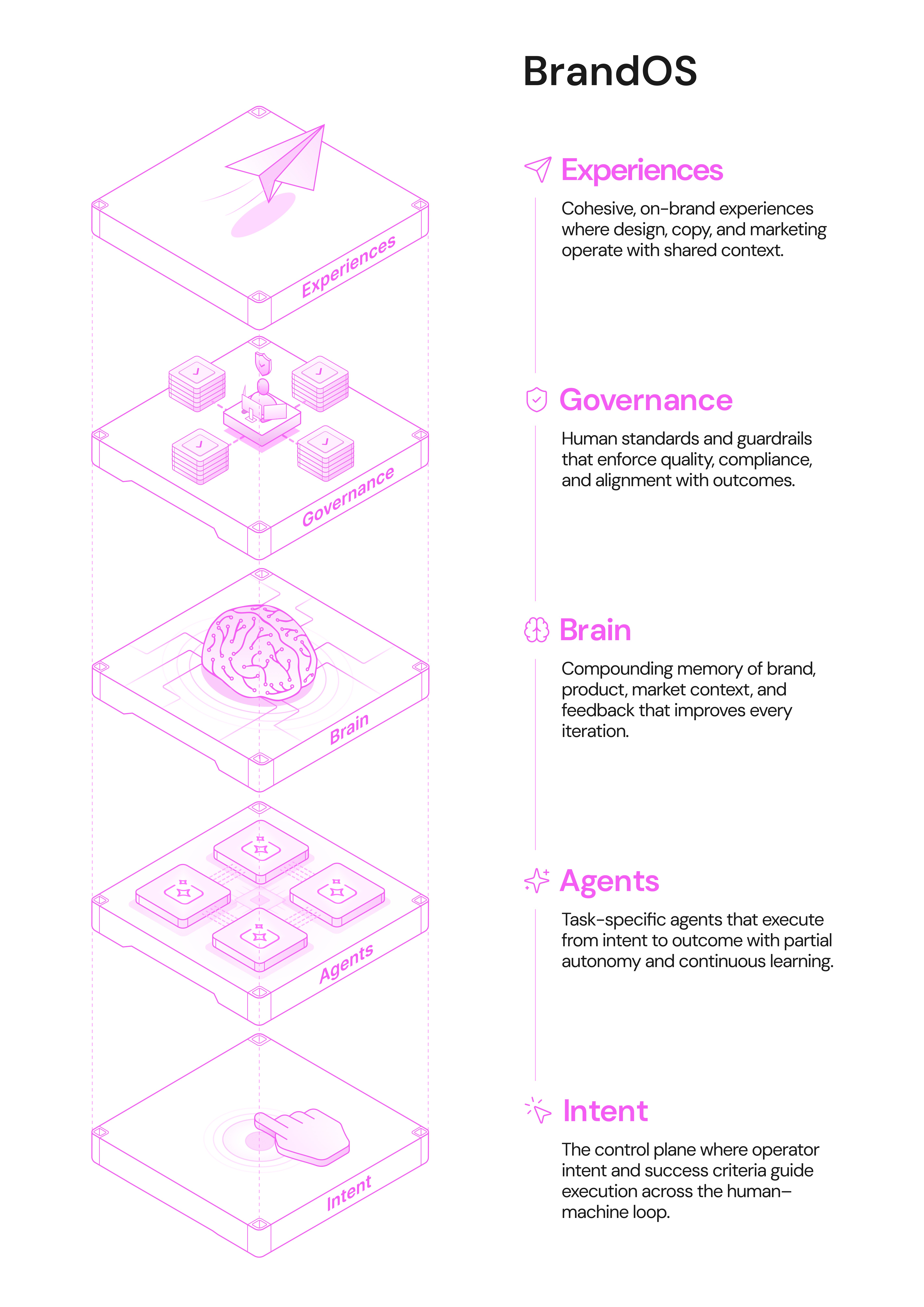
It is an operating system designed for high-agency operators to execute, learn, and compound outcomes. It is the infrastructure your marketing runs on, designed to deliver consistent, on-brand outcomes and improve with every cycle.
The BrandOS architecture is built on five core layers:
A new era of marketing
As the cost of creation approaches zero, advantage shifts to those who decide what gets created, why it matters, and how it compounds. The teams that win pair high-agency marketers with systems that can hold context, enforce coherence, and translate intent into continuous action.
The result: marketing that runs at the speed of business, with velocity, quality, and autonomy.