Back to Blog
BrandOS

Great content can never be written in a vacuum. It lives at the intersection of your product, your sales conversations, and your market/ICP signals. But when anyone can open a chat box and generate content in seconds, how do you ensure yours doesn't sound exactly like your competitor's?
Because your readers have already tuned out. Ad blockers, LinkedIn fatigue, banner blindness. They're not seeing your posts. So how do you make them stop and think?
Step 1: Stop letting ChatGPT smoothen your POV into nothing.
Magi's BrandOS was built for the marketer who knows their company has more to say than ChatGPT’s latest reply. It learns from your company’s knowledge bank, your Slack, your Gong calls, your sales notes, and pairs all that with autonomous competitor and market research, to generate a constant pipeline of ideas and campaigns that sound like your product team, your sales team, and your founders finally got in the same room.
If you're a B2B marketer who has tried using ChatGPT to scale your content and walked away with output that was okayish but felt like it could have come from any company in your space, this comparison is for you. If you're evaluating an AI-powered content creation platform that goes beyond writing assistance and actually understands your market, your ICP, and your pipeline, read on.
Yes, ChatGPT is a good AI writing assistant. No, that's not the same as an AI marketing engine.
ChatGPT is a general-purpose assistant optimized for flexible, ad hoc help. For a founder or first marketer in B2B, it helps with quick prompts and small edits that you can use to ideate on your campaign, draft quick copies or summarize long customer calls.
It helps B2B marketers with quick ideas and angles, rehashing your copy’s tone, grammar checks, and creating first drafts for posts. But using it as your GTM system is the start of marketing built on AI slop. And here’s why:
You must rebuild context in most sessions.
There's no memory of your last campaign, no awareness of your ICP, no signal from your market.
Prompt styles drift as more people use it.
Brand voice becomes hard to enforce across many contributors.
Campaigns, nurture programs, and launch bundles are still orchestrated by hand in spreadsheets and docs.
ChatGPT is not opinionated about B2B workflows. It answers questions, but it does not reliably run recurring rituals like weekly SEO or AEO content, launch bundles, or monthly customer updates.
As AI use scales, governance and consistency become the main problems.
Doesn’t take into account what the rest of your company or your competitors is learning, to be able to come up with a strong enough POV
"My ChatGPT is not as good as someone else's ChatGPT, because they may be getting far more insights and context from their conversations. Those tiny differences slow us down a bit when it comes to maintaining a unified brand voice."
Flora Leiker, Marketing Leader, Payactiv
Magi: The AI powered content creation platform for B2B marketing teams with a POV
Magi is an AI powered content creation platform built for B2B marketing teams. It ingests your company's knowledge, tracks your market, and keeps a constant pipeline of ideas running, so every piece of marketing content goes out grounded in strategy.
It runs repeatable workflows on a persistent BrandOS foundation, the operating system for your GTM campaigns, SEO and AEO content, lifecycle emails, and sales enablement, without rewriting instructions every time.
BrandOS holds your voice, ICPs, positioning, and approved messaging. Define what good looks like once. Reuse it across every motion your team runs. Specialised agents do the heavy lifting. A Research Agent ingests Slack, Notion, and Google Drive. An Ideation Agent produces campaign ideas, angles, and hooks. A Content Agent drafts blog posts, nurture sequences, one-pagers, and product emails, all from the same BrandOS, consistent at any volume.
Human judgement shapes the final output. But it arrives already grounded in your brand, market, and product.
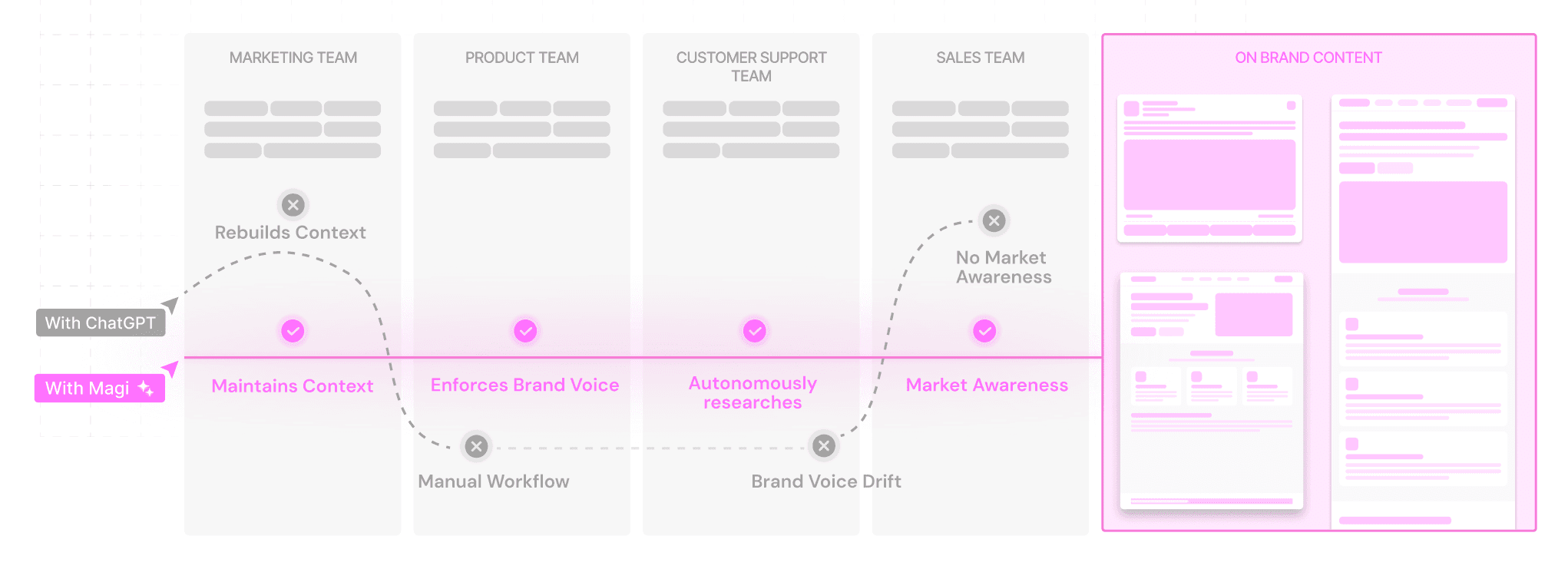
ChatGPT vs Magi: What a B2B inbound marketing engine looks like next to a general-purpose AI
Category | Feature | ChatGPT | Magi |
|---|---|---|---|
Brand Intelligence | Brand & company knowledge | Doesn’t encode institutional knowledge or memory between sessions. You re-paste your positioning, ICP, and tone every single time. Context is capped by token limits, longer your brand doc, less room for actual output. | BrandOS ingests your brand once and learns continuously, tone, positioning, ICP, product nuances. Setup takes a few hours. The more feedback you give, the sharper it gets. Knowledge doesn't walk out the door when someone leaves the team. |
Research & Intelligence | Autonomous market research | Reactive only. ChatGPT has no ability to monitor your market independently. It can help you research when you ask, but its training data has a cutoff date and it has no access to live competitor activity, trending topics, or ICP signals without plugins. | Autonomous research runs in the background continuously tracking competitor moves, trending topics, market signals, and social activity. You wake up to a pipeline of ideas grounded in what's actually happening in your market right now. |
Marketing Strategy & Campaigns | Built-in marketing expertise | ChatGPT knows about marketing the same way it knows about everything else, from the internet. No trained marketing judgment, no opinionated frameworks, no sense of what actually moves B2B buyers. Expertise is whatever you bring to the prompt. | Years of marketing expertise and best practices are baked into every prompt, workflow, and campaign structure. Plus a human team of strategists available to help you think through positioning, campaign logic, and content strategy. |
Marketing Strategy & Campaigns | Point of view | The internet's average. ChatGPT is trained on what everyone has written, which means its output reflects consensus. The more people use it for B2B content, the more everyone's content converges toward the same well-formatted mediocrity. | Synthesized from your product team, your sales conversations, your founders' thinking, and your market signals. Content that sounds like your best people were in the room when it was written, because in a sense, they were. |
Content Workflow | Content formats and Templates | Text output in a chat box. Copy it, format it, paste it manually where it needs to go. No native understanding of format-specific requirements, a LinkedIn post and a landing page come out structurally identical until you re-prompt. | LinkedIn posts, blogs, emails, landing pages, and one-pagers, each produced with awareness of the format's requirements and marketing best practices. Plus, templates, preconfigured and customizable helps you Channel-native output, not text you have to manually reformat for each destination. |
Research & Intelligence | Social listening | None. ChatGPT has no ability to monitor social channels, track influencer content, or flag competitor campaigns. You'd need separate subscriptions of tools to feed those signals in. | Tracks what your key influencers and competitors are creating, surfacing those signals for your ideas pipeline. Competitive intel and social trends feed content strategy automatically. |
Content Workflow | Content workflow structure | Each content goes through the Prompt → Answer → Re-prompt → Re-edit unstructured workflow. There's no review, or collaboration layer. You either use what it gives you or start again. Every edit means re-prompting, losing context from the previous output. | Each content goes through the Brief → Outline → Draft workflow, an intentionally structured flow to ensure reviewers can collaborate, ask AI and edit at every stage before the final content is generated. Reduces chances of redo and each piece is grounded in strategy. |
Research & Intelligence | Call & conversation intelligence | Your buyers’ language from sales and customer calls doesn’t automatically feed into ChatGPT unless you paste transcripts manually each time. | Meeting notetaker integrations for Magi to learn directly from your sales conversations. Real buyer language informs your content so it sounds like it was written by someone who's been on the calls. |
Research & Intelligence | Knowledge ingestion | Knowledge exists in what you remember to attach and write in the prompt. Whatever context you don't manually include, doesn't exist. Slack conversations, Notion docs, internal wikis, can be connected but it’s not automated. | You can add Magi to Slack threads and other company sources that you want it to listen to. It retains context from these threads so that your knowledge stays current without anyone remembering to update it. |
Brand Intelligence | AIQ (Agent IQ) | Every user on your team plan starts from scratch. The quality of output depends entirely on how well each individual prompts. A senior marketer and a new hire produce wildly different results from the same tool. No shared intelligence layer. | AIQ (Agent IQ) collects and processes user feedback to continuously train the AI. Your best marketer's voice, instincts, and editorial judgment become the standard output for everyone on the workspace, not just themselves. |
Marketing Strategy & Campaigns | Ideas pipeline | You. Every idea starts with a prompt you write. ChatGPT doesn't proactively surface content angles, flag trending topics, or suggest what you should be talking about based on your market. The blank chat box is always waiting for you. | A constant pipeline of ideas generated from autonomous research, social listening, competitor activity, and your company knowledge, running continuously in the background. You come in to a queue of angles to evaluate, not a blank page to fill. |
Content Workflow | Campaign structure | No concept of campaigns. Every piece of content exists in isolation, a prompt answered, a conversation closed. There's no way to categorize content by ICP, product, or persona. | Every piece produced is anchored to campaign objectives, so your content output stays super contextual You create campaigns specific to each market, ICP, product, and persona, each with a detailed brief and research topics that guide the AI. |
Content Workflow | Multimodal model selection | One model for everything, blog posts, ad copy, image prompts, social posts. No way to route different content types to the model best suited for each job. You get a compromise on every format. | Multimodal architecture enables you to work with the best model for each content, optimized for long-form blog writing or punchy social posts or image generation, ensuring best-in-class output for every format. |
Content Workflow | Publishing & distribution How does content actually get out the door? | None. Copy, paste, publish yourself. No integration with LinkedIn, CMS platforms, or HubSpot. Every piece of content requires a manual handoff from ChatGPT to wherever it needs to live. | Publish directly from Magi to LinkedIn, your CMS, and HubSpot. Content goes from draft to live without leaving the platform. Calendar view lets you schedule, assign, and coordinate publishing across the team. |
Marketing Strategy & Campaigns | ABM campaigns | Not supported. ChatGPT can help write personalized copy if you paste account context in, but there's no account intelligence, and no way to run ABM at scale | Pulls context from your CRM, sales notes, and live market data to generate campaigns that speak to specific accounts. |
The era of AI slop is over. Here's what B2B AI marketing looks like now.
The core decision is disconnected prompts versus a unified marketing engine.
The best setup in practice is simple. ChatGPT stays in your toolbox for personal productivity: quick rewrites, one-off thinking, meeting follow-ups. Use Magi as the AI operating system for your GTM: weekly research synthesis, briefs, content packages, multi-channel campaign drafts, and BrandOS governance. Your team gets flexible prompting plus a shared BrandOS and agentic workflows.
This combination keeps all the ritual of marketing: campaigns, content, and SEO or AEO running every week. This also aligns with the broader shift toward agent teams and enterprise agent platforms-e.g., major model providers introducing "agent teams" as a coordinated way to execute multi-step work.
You still need humans for strategy, approvals, and brand judgment. The goal is fewer blank pages, not eliminating taste. Which is where our extended team of marketing experts comes in handy.
Frequently Asked Questions
Q. What are the best AI marketing software solutions?
A. AI marketing software solutions beyond content generation connect to your CRM, ingest company knowledge, run autonomous research, and anchor content to campaign objectives. Magi is purpose-built for B2B marketing teams.
Q. What tools provide the best AI writing assistance?
A. AI writing assistance for B2B combines language models with brand intelligence — so output reflects your voice. Magi layers campaign context, sales intelligence, and market signals onto every piece of marketing content, so it reads like your team.
Q. What are the best content marketing platform solutions?
A. Content marketing platform solutions combine ideation, production, collaboration, and distribution in one workflow. Magi goes from autonomous idea generation to brief, outline, draft, and direct publishing on LinkedIn, CMS, and HubSpot.
Q. What are the best artificial intelligence writing assistant tools?
A. Artificial intelligence writing assistant tools for B2B need to know your positioning before producing a word. Magi's BrandOS and AIQ compound continuously, getting sharper with every interaction.
Q. What are the best AI post generator tools available?
A. AI post generator tools produce content grounded in your company's POV. Magi generates LinkedIn posts anchored to an ICP, a persona, and a live market signal, not AI slop dressed up with punctuation.
Q. What's the biggest risk of using ChatGPT as your marketing system?
A. You'll get speed, but you'll also get drift: inconsistent context, voice, and workflows as more people contribute.
Q. Can Magi and ChatGPT work together?
A. Yes-use ChatGPT for individual tasks and Magi for shared BrandOS, governance, and repeatable weekly workflows.
Q. What's one fast step to improve AEO/LLMO this quarter?
A. Run a freshness audit-recently updated content is reported to be 3.2x more likely to be cited by real-time engines.