The Best AI Agents for Marketing are Rooted in Live Research
Great content starts with research, not writing. Inside Magi's Research Agent: continuous source monitoring, a shared knowledge base, cited weekly reports, and autonomous ideation for B2B teams.

Quick answer
The best AI agents for marketing work from a shared research layer (like Magi’s Research Agent)
It is scoped to campaigns, learning from the sources, monitoring competitors, influencers, and topics you configure, continuously, in the background
Everything it collects lands in a shared knowledge base with source trails, open to your team and every other Magi agent.
It compiles a weekly research report, grouped by campaign and by who each signal matters to, that you can email to stakeholders or customers.
The research it gathers feeds autonomous ideation, so content starts from a grounded brief instead of a blank prompt.
Of all the types of AI marketing agents, the research agent decides whether everything downstream is grounded or guessed.
What makes an AI marketing agent production-grade?
Great content without the slop is grounded in great research. That is the thesis. Most AI marketing agents fail in production because their memory is ad hoc, stale, or impossible to audit, so the writing comes out fluent and wrong. Magi's Research Agent is the always-on layer that monitors configured sources, captures internal and external knowledge, and feeds it into downstream ideation and content work. It sits at the front of the workflow, not off to the side as a standalone writer.
The best AI agents for marketing do more than autocomplete. They run a research-to-knowledge-to-output loop that starts with current context and ends with work your team can defend. In Magi, Market, Brand, and Product are the three connected domains the agents — Research, Idea and Content — reason from. AI marketing agent software becomes useful only when it pulls the right slice of that context for the next job, instead of starting every draft from zero.
Why does the DIY research stack fail under scale?
The DIY setup holds together when the team is small. Brand doc in the prompt, research folder in Drive, a custom GPT, and rotating set of links in Slack. It feels efficient until the market moves and the prompt doesn't, one teammate updates the context doc and another drafts from the version before it, and the product nuance still lives in one person's head.
Scale breaks it completely. When AI is generating ten times the output, reconciling Market, Brand, and Product can't happen once per brief, it has to happen at every generation step.
Approvals pile up, drafts drift, and the one senior person who holds all the context becomes the bottleneck.
That's the deeper problem: once output gets cheap, context gets expensive.
The more you generate, the more you need current knowledge at every step. A research agent that runs continuously, monitors your sources, and files what it finds is what keeps the system from collapsing under its own output.
How Magi’s Research Agent compounds over time
A research agent is a loop that compounds, not a one-time scrape. Signals come in from configured sources. Magi stores them as knowledge objects with source trails. Ideation turns that into an idea pipeline. Content work starts from a brief and an outline, knowledge already attached.
The detail that makes this credible is inheritance. Magi's buyer hierarchy runs Market to ICP to Persona, so downstream work inherits context instead of flattening it. That is the difference between types of AI marketing agents that demo well and a research agent that stays grounded in real go-to-market conditions.
Where research starts: your Market, Brand, and Product
A research agent is only as good as the sources it is pointed at. Those sources come from how you have already described your business. In the Market, Brand, and Product domains you add competitors, influencers, your ICP, and your market. The Research Agent reads those entries and monitors them continuously in the background.
Competitors carry a name, a description, and the sources Magi should watch: website, blog, and LinkedIn company page. Influencers are individuals: analysts, podcast hosts, and category thinkers who shape the conversation, each with their own sources to monitor. ICP and Market frame what counts as relevant. For how Brand is structured, see the BrandOS deep-dive.
What this changes: research stops being whatever a model finds on the open web. It becomes continuous monitoring of the competitors and influencers you chose, refreshed without anyone remembering to look.
Campaign-level whitelists: How research stays scoped
A research agent is trustworthy only when you control where it learns. Magi handles this per campaign, with whitelisted sources, blacklisted sources, and research topics.
Whitelisted sources are where a campaign is allowed to learn. Blacklisted sources are what it must ignore. Research topics keep each run scoped to what the campaign is about. This matters because two campaigns can need opposite behavior from the same agent.
Take a competitor-research campaign. You want the Research Agent scraping competitor sites, tracking launches, surfacing positioning shifts, because that is the job. Now take a product-updates campaign for the same brand. Competitor content has no place in it, and pulling a rival's messaging into your launch copy is exactly the failure you are avoiding. Same agent, same brand, two source policies, both set by you.
What this changes: the agent learns inside the boundaries you set, so a competitor never bleeds into a launch, and no campaign gets polluted by noise from outside it.
How do citations and source trails stay auditable?
If you cannot see the source, you cannot defend the claim. Everything the Research Agent collects is cited. Content links back to the knowledge object it drew from, and each object links back to its source: the citation, the excerpt, and the trail from evidence to takeaway. You can check where a point came from before it turns into messaging or copy.
That traceability is live today. Richer in-document citation surfacing inside long-form outputs is still in progress.
The shared knowledge drive: where everything your team knows lives
Collection is table stakes. The feature is structured, reusable, shared memory. The knowledge base is the drive your team and Magi work from, so content stays grounded in one shared context instead of scattered across folders and chat threads.
Two things fill it.
What you bring in. Every artifact your team produces or shares lives here, internal and external alike: PDFs, sales collateral, one-pagers, past content, research reports, images, videos, and the URLs you send to prospects, teammates, customers, and engineers. Some flows in automatically through integrations like Fathom and Slack, so prospect calls, meeting recordings, and shared threads land without anyone filing them. The rest you upload. The nuance from a customer call, and the one-pager a rep sent last quarter, stop living in one person's head.
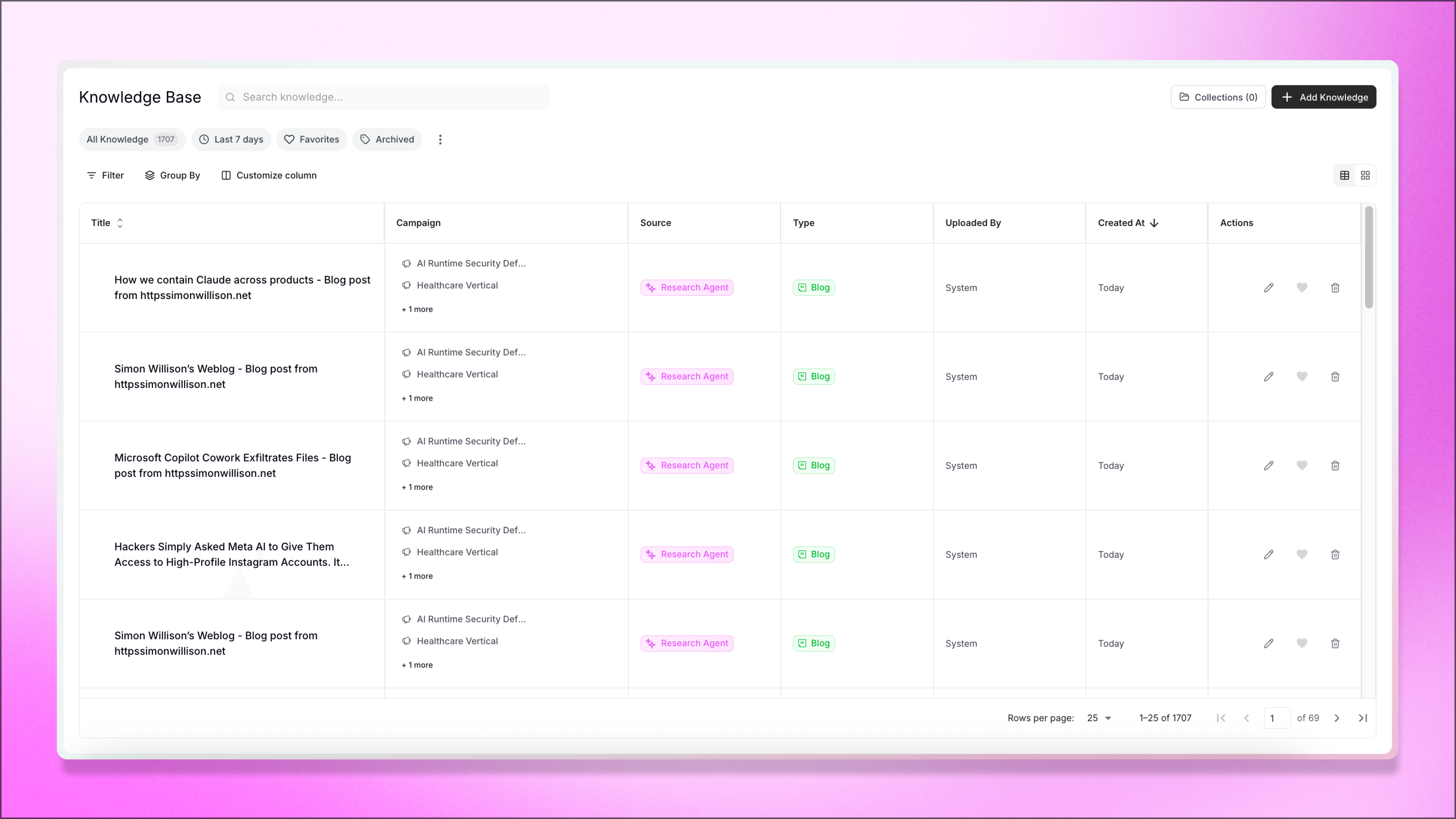
What the Research Agent adds, continuously. In the background, it keeps adding to the same pool: influencer LinkedIn posts, competitor blogs, long-form articles, and the URLs that matter to your active campaigns. The drive grows on its own while the team works.
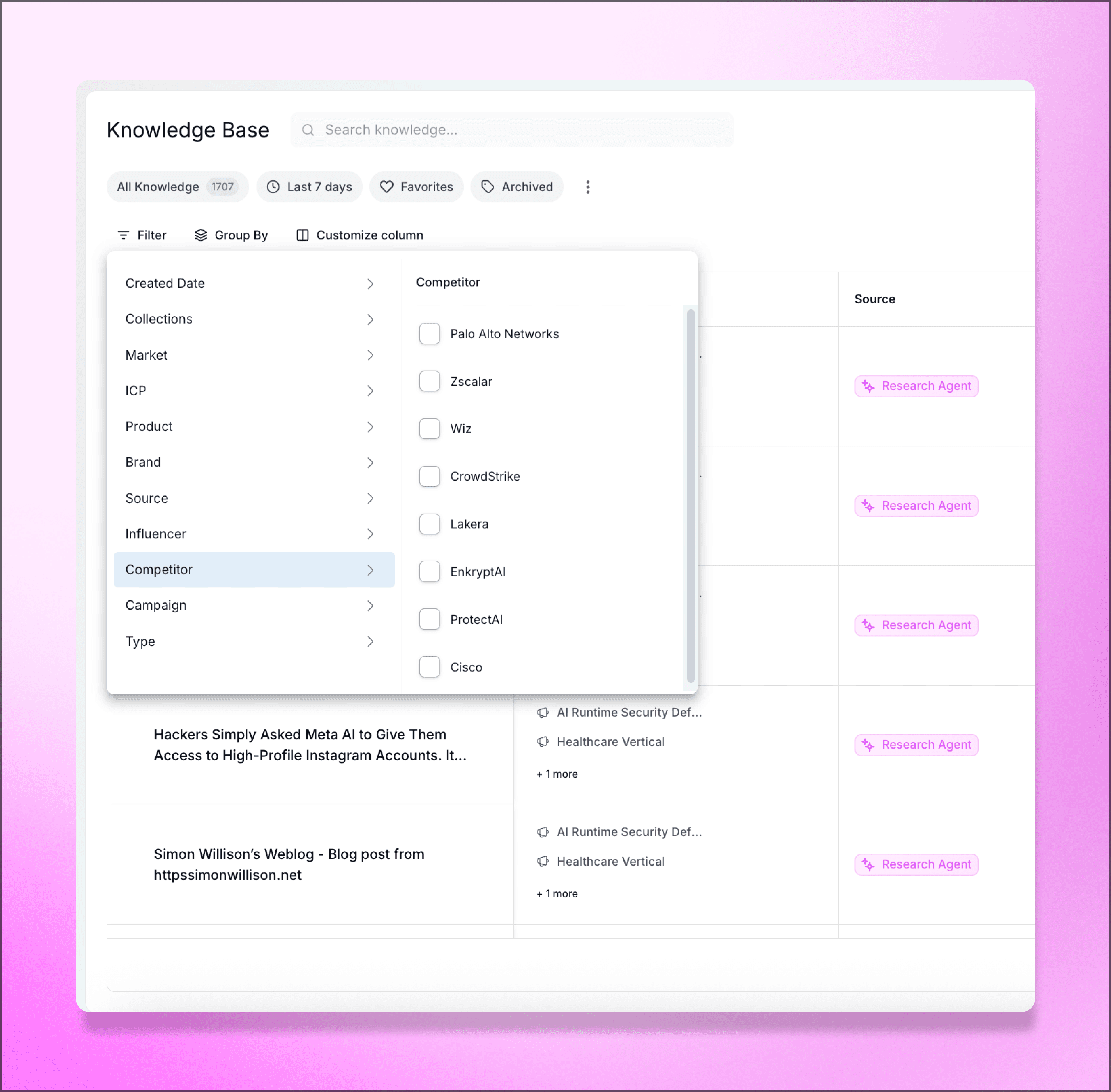
How it is structured. Every item carries its Campaign, Source (for example, Research Agent), Type (Blog, LinkedIn, PDF, image, video, and more), and who uploaded it. You can search everything, filter by Market, ICP, Product, Brand, Source, Influencer, Competitor, Campaign, or Type, and group items into Collections. The research agent doubles as a knowledge agent: it files what it fetches, so a library in the thousands stays navigable.
How this is used: when you brief a campaign, the relevant knowledge is already there, already scoped, already cited. You curate what matters and move to a brief, instead of rebuilding the market from scratch before writing one decent paragraph.
What does the weekly research report contain?
Teams cannot live in dashboards. So Magi rolls the week's monitoring into one readable Marketing Research Report, curated automatically and ready to send to anyone, including stakeholders and customers outside the platform.
The report is organized the way a marketer reads.
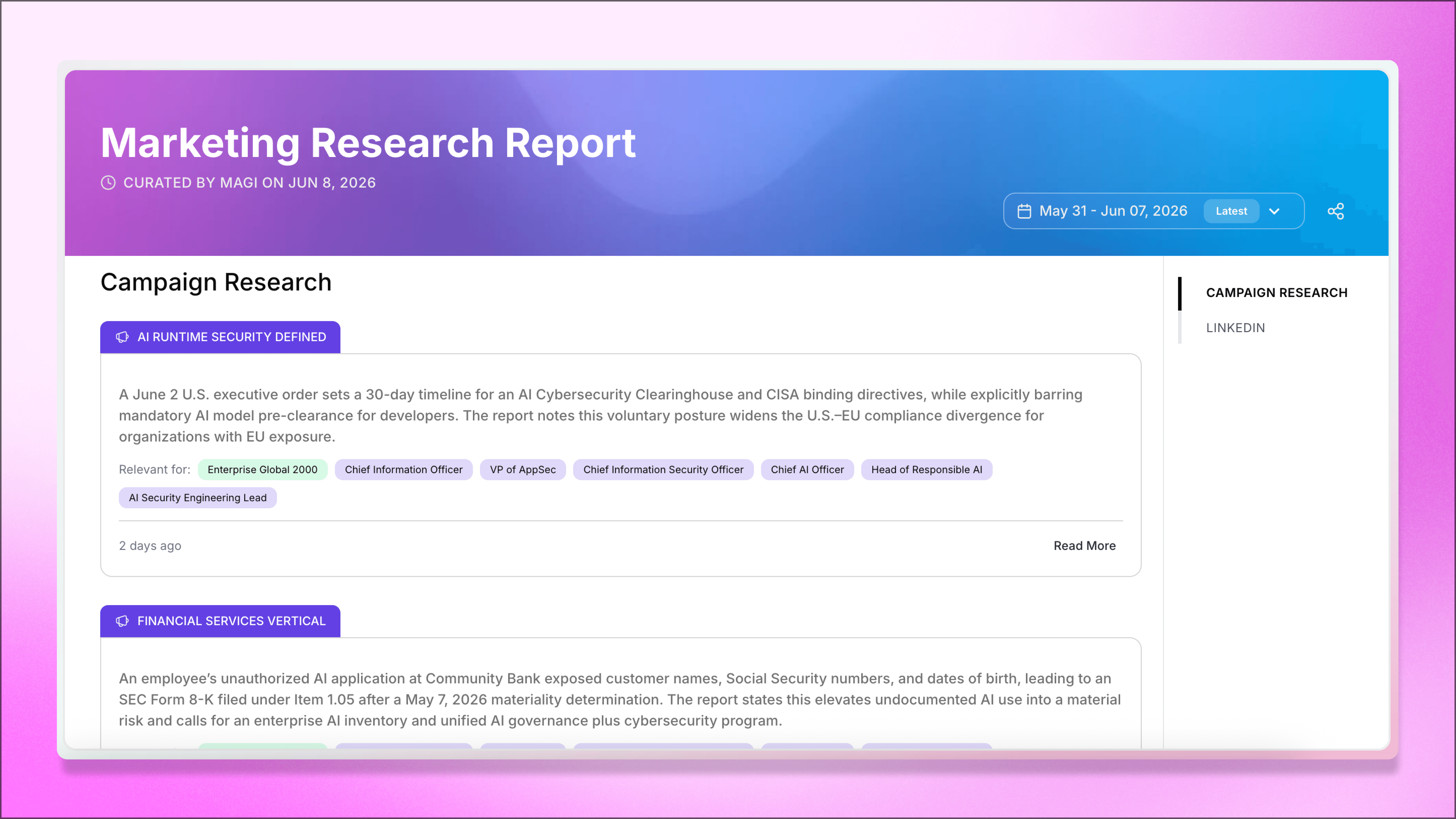
Campaign Research groups the week's signals by campaign, so Brand Awareness and Security Vertical each get their own section.
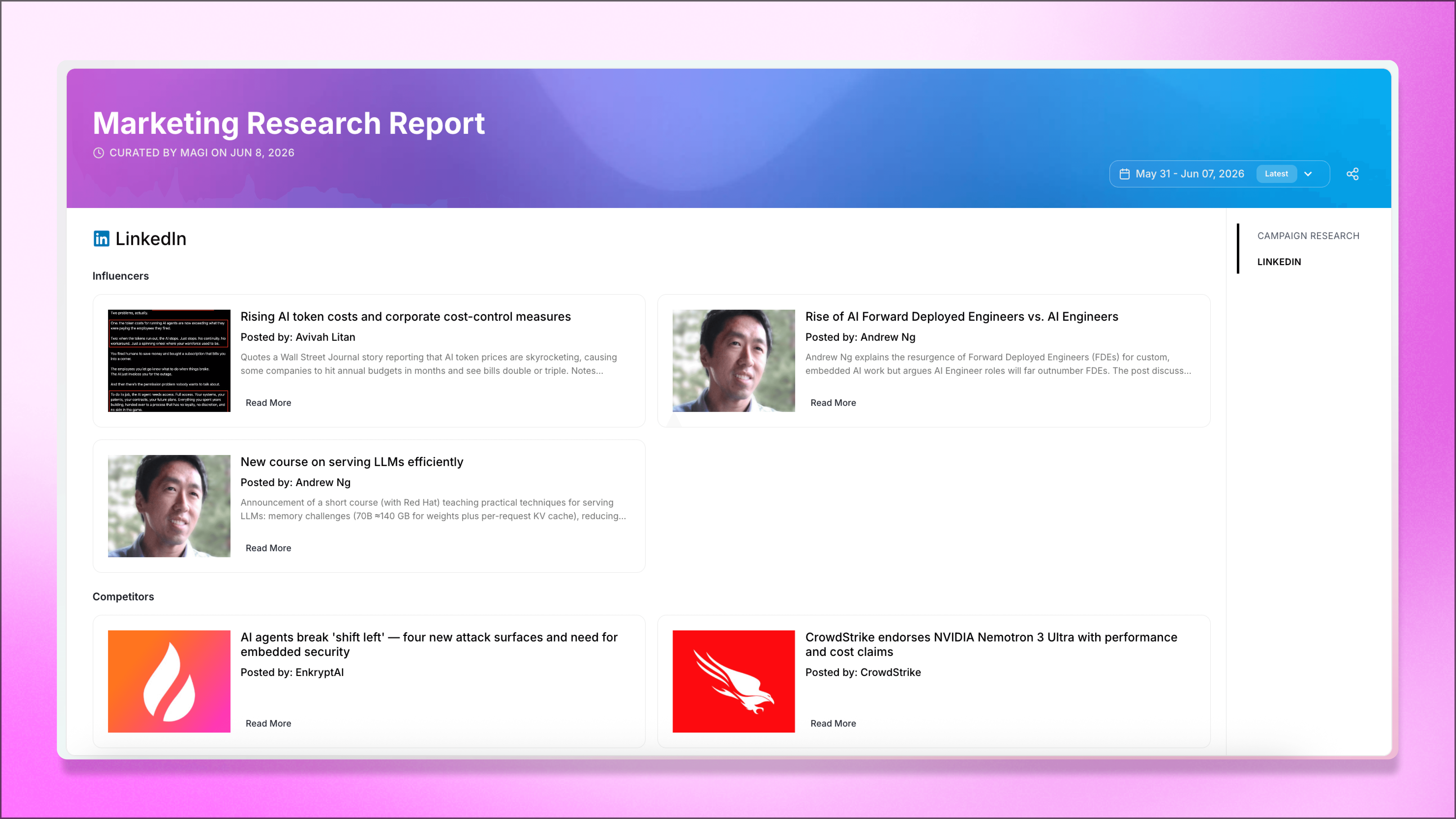
A LinkedIn block splits the social signal into Influencers, Competitors, and Blogs, so category commentary sits next to what competitors published and what is worth reading in long form.
Every card carries a plain-language summary, Relevant for tags naming the segments and personas it matters to (Startups, Scaleups, Enterprise, Founder/CEO, Head of Marketing, VP of Demand Generation), the date, and a Read More link to the source. A week's report might surface a competitor's product launch, an analyst call from a Gartner summit, and posts from the operators your buyers follow, each tagged with who on your side should care.
How this is used: Monday planning starts with the report, then moves to ideas, then briefs. That is what a weekly research report does for AI agents for B2B marketing, and why customers forward it straight to stakeholders instead of rewriting it.
From research to ideas, automatically
The workflow is the product. The content is one output of it. Once the knowledge base is current, the Ideation Agent generates campaign angles, hooks, and ideas from it, autonomously. You triage the ideas, move one into a brief, pause at the outline, and only then draft with the Content Agent.
Research Agent, Ideation Agent, and Content Agent share the same knowledge layer and campaign scope. That shared memory is how to use AI agents in marketing without turning your team into full-time prompt mechanics. Repetitive setup moves into the system, and judgment shows up where it matters, on the ideas and the decisions.
How AI agents for B2B marketing work in practice: AccuKnox
AccuKnox is a cloud security company, and in security, research is close to the product. Their readers expect current, time-sensitive updates, the kind that go stale in days. Before, pulling those signals together meant tracking sources by hand and rebuilding context every time something was worth writing about.
With the Research Agent monitoring their security vertical continuously, the weekly report now lands current signals already grouped by campaign and tagged by who they matter to. Their team starts from that. A time-sensitive development becomes grounded, cited content for their readers while it is still timely, instead of after the moment passes.
See the before and after in one frame
Same request, two starting points. A generic AI tool starts from a blank prompt and last week's assumptions. Magi starts from current, cited, campaign-scoped knowledge the Research Agent already gathered and filed. Speed is the obvious takeaway; the real gain is starting from the right context, with the receipts attached.
What did we have to solve to keep research useful?
The hard part was knowing what to leave out when researching for marketing. Comprehensive memory is valuable at the system level, useless poured into every prompt. Dump everything in and you get an everything-bagel context that feels informed and still misses the point.
That is why the ontology logic matters. Structured domains let the system stay exhaustive in memory and selective at generation. The research layer keeps gathering; the agent doing the next job fetches only what that job needs. The same logic drove scoping the agent per campaign, so a product-updates campaign can never reach for the competitor sources a competitor-research campaign depends on. More research helps only if the system is disciplined about which part it uses when.
Great content without the slop starts with research
The best AI agents for marketing are only as good as the research layer underneath them. The winning layer is governed context and live signals held in shared memory with citations attached. Generation is the easy part now. The hard part is knowing what matters right now, why, and where it came from. Get the research right and the writing stops being a gamble.
Open Research Agent
Already on Magi? Open Research Agent in your workspace and review this week's report and idea pipeline.
New to Magi? Book a demo to see the Research Agent configured against your marketing function.
Frequently Asked Questions
What are the best AI agents for marketing?
What is an AI research agent?
How do you use AI agents in marketing without losing quality control?
What types of AI marketing agents matter most in practice?
How does an AI research agent help B2B marketing teams?
What is a knowledge agent in marketing?
What makes AI marketing agent software production-grade?
How often does the Research Agent run?
Can the weekly research report be sent to customers or stakeholders?
Does Magi cite its sources?
Methodology: this release note describes Magi's Research Agent as it ships today, based on the live product and Magi's current product roadmap. Capabilities labeled live are in production; anything described as rolling out or on the roadmap is marked as such. Published by Magi.