Content Ideation Agent: How Marketing Teams Stop Starting from Scratch
Magi's Ideation Agent creates ideas the moment new knowledge comes in, grounded in your campaign signals.

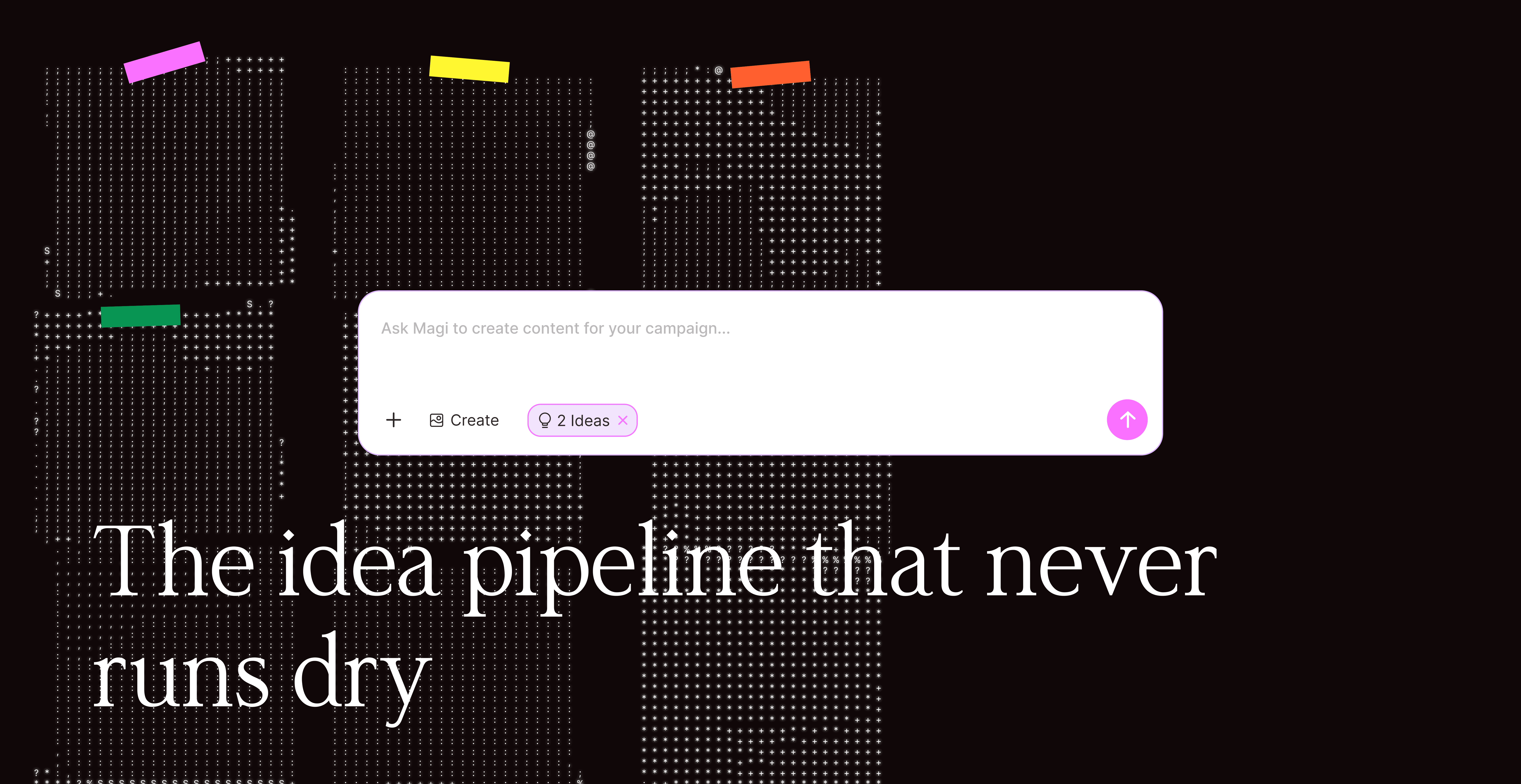
Most AI marketing tools start the same way. You type, they generate. No matter how many drafting tools you stack on top of one another, the blank page never disappears, it just gets handed to whoever owns the prompt box.
Magi's Ideation Agent, an AI agent that continuously generates ideas, has them already waiting when you log in, grounded in your campaign, your knowledge, and your brand's POV on what's happening in your market this week. What follows is how the content ideation process works at Magi, and how the Ideation Agent runs that thinking continuously.
Why generic AI tools can’t do content ideation
Generic AI tools optimize for the draft, not the idea. ChatGPT, Jasper, Claude, Copy.ai all run the same workflow. You arrive at the tool already knowing what you want to write, you type, you get a draft.
Two structural reasons they can't do ideation:
No persistent memory of your campaign or your brand. Every session ends when you close the tab. The tool doesn't remember your ICP, your brand voice, or what last quarter's top-performing post did.
No live read on your market. Models have a training cutoff. They can't see what your influencer posted this morning or what your competitor announced last week.
Ask any of them for ideas directly, and what comes back is whatever was already in the training data, ideas you could have generated from a Google search. They're built for writing. Content ideation AI is a different layer entirely which they don’t have.
For the full breakdowns on specific tools, our Magi vs ChatGPT and Magi vs Jasper comparisons go further.
How we think about content ideation process at Magi
Two principles shape how the Ideation Agent was built. Both are positions, not features.
Ideas can't be on-demand
You can't walk into a prompt box and ask for an idea when the prompt box has no context on your brand or your market. A generic AI tool doesn't know your ICP or what your founder said on the Fathom call yesterday. Even when you ask it explicitly for ideas, what comes back is the statistical average of everyone else's content on the topic. Ideas pulled from a generic model are empty by default.
Behavioral guardrails are what turn topics into ideas
Topical relevance gives you "write about denial rates this week." That's a topic. An idea is the angle on the topic that makes a buyer stop scrolling. Strong ideation reasons about how B2B buyers actually decide.
How Magi's Ideation Agent generates content ideas for marketing teams
The Ideation Agent is the second agent in Magi's pipeline. It wakes up every time new knowledge lands in the platform, and turns that knowledge into content ideas scoped to a specific campaign. Three layers do the work.
Knowledge grounding
What it does. The agent translates a specific signal into a marketing angle, and one click on the idea opens the source excerpt, a TLDR of the document it came from, and the agent's reasoning for why the angle fits your campaign's ICP.
How this is used. An influencer in your category posts something sharp on Sunday night. The Ideation Agent surfaces an angle Monday morning, cited to the original post. You click the citation, confirm the source is real, edit if needed, and ship.
Campaign context
What it does. The agent reads from your BrandOS and your campaign config. Every idea inherits the full marketing ontology before it's surfaced, including market, ICP, persona, brand voice, and product positioning.
How this is used. A cloud security AI company runs two campaigns in parallel, one for runtime security and one for compliance automation. The same source signal, say a new CISA advisory on a critical vulnerability, generates a different idea for each campaign, because the buyer the angle is shaped for is different. An idea built for the compliance buyer doesn't accidentally show up in the runtime security queue.
Behavioral marketing principles
What it does. The agent applies principles from Prospect Theory and Cialdini's work on persuasion (loss aversion, social proof, anchoring, scarcity, reciprocity) when shaping every angle.
How this is used. A new industry report drops showing attacker dwell time increasing across cloud environments. The Ideation Agent applies loss aversion to frame the cost of every additional day, layers in social proof against what peer security teams are already doing, and ships the angle: "The cost of every extra day attackers spend in your cloud, when 6 in 10 enterprise security teams have already cut dwell time in half.”
How Magi keeps the ideas queue sharp over time
Magi's content ideation process treats every idea as part of a learning loop. Once an idea is generated, the platform handles three more things before it ever becomes content.
Recency and relevancy
Ideas have two axes that matter, when they came in and how relevant they are to your campaign. The Ideation Agent ranks against both. A breaking signal from an influencer your CMO actually trusts will rank above a deep research synthesis from three weeks ago, even if both are technically about the same topic. The team always sees the most actionable ideas at the top of the queue.
Collections
Every idea in the queue can be saved into a Collection. A founder bookmarks 50 ideas over a month into a personal Collection, and that Collection becomes the input for their own writing rhythm. Collections turn a ranked queue into curated pipelines, one per owner.
AIQ compounds the team's judgment
Every thumbs-up and thumbs-down on an idea trains AIQ. Liked ideas climb the queue for everyone in the workspace. Disliked ones stop appearing. Over time, your senior marketer's editorial instinct becomes the agent's default. A new hire opens Magi on day one and sees ideas that already match the brand's POV, because the team has been training the agent for months.
Where the Ideation Agent sits in Magi's content planning workflow
The Ideation Agent doesn't work as standalone software. The pipeline is the product.
Research Agent. Pulls market signal continuously from competitors, influencers, web sources, and uploaded knowledge. Without it, ideation has nothing to ideate on.
The Ideation Agent. Turns that signal into campaign-scoped angles, ranks them, learns from your team's feedback.
Content Agent. Picks up the chosen idea, runs Brief → Outline → Draft, inherits the citations end-to-end.
All three agents reason from the same BrandOS, which is what keeps the angle consistent from "interesting signal Monday morning" to "published blog Friday afternoon."
For the architecture underneath, our BrandOS deep dive and the AI-native marketing system post walk through how the layers connect.
What changes when content ideation runs continuously
Three outcomes show up almost immediately, and they all come from the same architecture.
You never start with a blank page
Monday morning becomes idea curation. The work that used to take the first hour of your week, deciding what to say, is done while the team is offline. When you log in, the question is which idea to ship.
The team sounds like one brand
A senior marketer and a new hire pulling from the same Ideation Agent are working from the same brand POV and the same campaign context. Across LinkedIn, the blog, and any other channel the team is running, the brand holds.
Campaign-relevant insight surfaces
When a founder says something useful on a Tuesday Fathom call, the Ideation Agent picks out the campaign-relevant moment and surfaces it as an angle by Friday. Not the whole transcript, just the part that matches a campaign in play. The same selectivity applies to uploaded research, tracked influencer posts, and Slack threads marked for marketing. The agent doesn't pull everything. It looks for what's useful for an active campaign.
How 100ms uses the Ideation Agent
100ms, a healthcare AI platform with multiple ICPs and verticals to cover, uses the Ideation Agent to keep their content rhythm grounded in the right signal for each one.
100ms
Fathom transcripts from industry interviews. The team has calls with industry leaders constantly. Calls flow from Fathom into the Magi knowledge base, and the Ideation Agent pulls campaign-relevant moments into a steady stream of LinkedIn ideas.
Recurring deep research on healthcare segments. Research on different verticals runs on a configured cadence. Leadership browses the queue to form opinions on emerging shifts, even when nobody is actively writing.
Source traceability for healthcare AI. Every idea cites back. In a regulated category, the team needs to know whether a claim came from a peer-reviewed source, a competitor blog, or a Fathom transcript before anyone hits publish.
"This is fascinating, by the way. It can open up so many avenues of thought."
— Naresh Aggarwal, Head of Healthcare Solutions, 100ms
Stop staring at the prompt box
With Magi's AI content ideation agent, the angle is chosen before the draft begins, framed by a principle that moves the buyer, and grounded in a source you can click back to. The brand POV holds whether the post goes out from a CMO, a new hire, or the founder.
That's what content ideation AI delivers when it's built for marketing from day one. The thinking that used to take your Monday morning runs in the background, and by the time you log in, the only question left is which idea to ship.
Want to see the Ideation Agent run against your campaigns? Book a demo.
Frequently asked questions
What is content ideation AI?
How does AI content ideation work for marketing teams?
How is Magi's Ideation Agent different from generic AI tools like ChatGPT?
How do you use AI for content ideation?