
Back to Blog
Marketing

Claude Code started as a terminal-based coding assistant for software engineers. Today, marketers use it to pull competitor intelligence, test homepage positioning, turn sales calls into content, and build an extended workforce for themselves.
You do not need to know how to code to get started. Describe the outcome clearly enough, and Claude Code builds it. That bar keeps getting lower as the models improve, allowing non-technical marketers to also create full-blown marketing operating systems.
The harder question comes after the first build: can it scale across a team, department, or company? This guide shows you what to build with Claude Code, where those workflows break, and how to scale them as your business grows.
TL;DR
Master the Claude Code workflows that you can use to set up competitor intelligence, content operations, ABM, sales enablement, and brand systems from Day 1
Once you've built your first marketing workflow with Claude Code, learn how to host, maintain, govern, and scale it across your team.
Learn how Claude Code and Magi, the marketing OS lean teams rely on, complement each other, where Claude Code is limited, and how Magi's built-in marketing expertise delivers better outcomes.
Claude Code Use Cases: What Marketers Are Already Building
The strongest Claude Code marketing use cases share one trait: they turn recurring work into a workflow with defined inputs, a repeatable process, and a clear review point. You'll learn how to use Claude Code so it converts LinkedIn ad intelligence into a report, sales-call transcripts into publishable articles, 100+ account-specific ads from a template, and assembles custom sales decks from CRM data, all in a few clicks.
1. Research and Competitive Intelligence
Kamil Rextin built a /competitors skill that pulls competitor lists from G2 and TrustRadius, then links to a LinkedIn-ad-intelligence skill that analyzes ad activity and messaging before producing a formatted PDF report.
2. Content Systems
Turning sales calls into published content: Benjamin Gilbert at Base Operations built a six-stage workflow that turns sales-call transcripts into structured intelligence, SEO/AEO articles, and LinkedIn posts, with human review before publication.
Enforcing brand voice at scale: Tim Metz at Animalz extracted editorial patterns from published work, turned them into a style guide, and used eight focused agents to evaluate separate editorial dimensions.
Running an entire content team, solo: Kieran Flanagan built an 11-skill content team connected by an orchestrator. It researches topics, develops audience profiles, studies his published work to model his voice, drafts for multiple platforms, and updates its skills using performance feedback.
Homepage positioning review: Emily Kramer built a skill that evaluates a B2B homepage against her positioning framework, grades the hero and full page, identifies missing answers, and suggests concrete fixes, including rewritten headlines.
3. Account-Based Marketing
Nick Lafferty at Profound used Claude Code to turn one ad template into 100+ account-specific LinkedIn ads. The workflow enriched his target-account list with competitor pairings, pulled logos through Logo.dev, and generated the campaign assets through Python so the process could be rerun without rebuilding it in Claude Code. The campaign reportedly reached a 5-6% click-through rate, compared with a typical 0.4% LinkedIn benchmark.
4. Sales Enablement
Patrick Spychalski's agency, The Kiln, built a workflow that turns HubSpot lead data into personalized sales decks. It scores each lead against the ICP, selects the most relevant service use cases, drafts the specification and slide copy, then sends the output to Gamma for deck production.
5. Personal and Social Content Distribution
Bojana and Barbara built a personal distribution agent grounded in the user's transcripts, podcast appearances, and writing samples rather than generic web content. It checks in through Slack three times a week, drafts a week of posts, and routes them to Buffer for human review.
6. Brand Systems and Visual Assets
Wyndo built a workflow that reads an existing website and stores colors, fonts, spacing, and voice patterns in a brand.json file, which was then used as the foundation for future carousels, decks, and reports.
7. You Don’t Have to Start From Zero
If you do not want to start from a blank file, Corey Haines maintains an open-source library of 51 skills across CRO, copywriting, SEO, ads, and RevOps.
Barona Case Study: What Changes When Claude Code Scales to 18 People?
Barona's CMO, Joni Helminen, turned individual Claude Code skills into a four-layer Marketing OS:
Foundation: Brand, ICP, positioning, messaging, and operating context.
Live data: Current signals arrive through MCP connections and keep the system grounded in changing inputs.
Execution skills: Narrow, task-specific skills use the foundation and live data to produce marketing work.
Feedback loop: Performance and review data improve the system over time.
Barona housed its foundation files, skills, templates, and MCP server in a private GitHub repository. Team members cloned it locally, while three administrators controlled edits to protect shared context. The rollout required Anthropic approval, cross-platform onboarding, and narrower task-specific skills after broad early versions underperformed.
Independent Great Workflows Do Not Make a Marketing Team
Once a Claude Code workflow needs to run unattended, stay current, or support more than one person, the work extends beyond the original build. The maintenance costs usually show up in six places:
What needs owning | What changes after the first build | Example |
|---|---|---|
Hosting and monitoring | A workflow that runs on a schedule needs deployment, alerting, and someone who notices failures. | Kamil Rextin |
Shared context and version control | Skills, source files, and brand inputs need one maintained version instead of local forks and stale references. | Corey Haines, Wyndo |
Governance and approvals | Access, model approval, review rules, and changes to shared workflows become ongoing operating decisions. | Barona |
Ownership when it breaks | Someone must own onboarding, diagnose failures, and decide when a workflow needs to be narrowed, rebuilt, or retired. | Barona |
Those costs do not land evenly. A solo competitive-intelligence skill and a shared content system create different maintenance burdens, which is why the ‘build vs buy‘ decision is best made workflow by workflow.
From Claude Skills to Marketing OS: What Must Be Centralized Before a Team Can Run It?
Workflow | Keep building in Claude Code when... | Move to a dedicated layer when... | What breaks first? |
|---|---|---|---|
Research and analysis | One operator can run it on demand, own the prompt, and check the result. | The team needs a dependable refresh, not a person remembering to run it. | Scheduling, monitoring, and recovery |
Shared content and brand systems | One owner can maintain the source files, workflow stages, and review loop. | Several contributors need the same brand context and standards without local forks. | A shared source of truth |
Team campaigns, ABM, and sales enablement | The project is bounded, the data is controlled, and a small group can review every output. | Live data, permissions, approvals, and repeatable execution have to work across the team. | Data access, approvals, and accountability |
Simply put: build when flexibility, portability, and direct control outweigh maintenance. Consider a dedicated layer when the output must stay shared, governed, and dependable across people or time.
Claude Code Gets You Started. Magi Keeps Your GTM Running.
Magi is the marketing operating system for workflows that outgrow one builder. It centralizes the operating work that makes shared execution dependable, while your team keeps control of the decisions that require business judgment.
Magi manages | Your team still owns |
|---|---|
Cloud infrastructure, workflow maintenance, and a centralized BrandOS and knowledge foundation. | Brand decisions, source inputs, and the strategic priorities that guide the work. |
Research, ideation, first-draft workflows, and a shared space for review and refinement. | Approvals, security and access rules, and the final judgment on what ships. |
See how shared brand context, research, drafting, and review stay connected in one workflow within Magi:
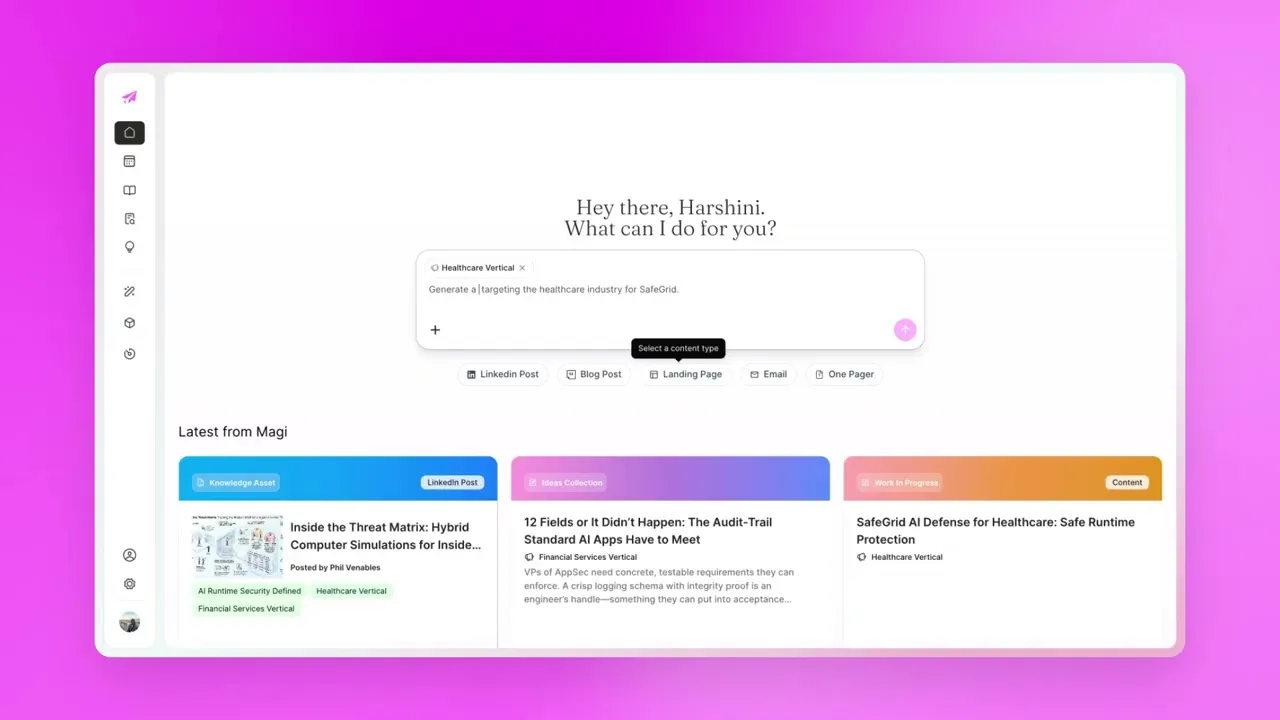
As Anthropic Models Advance, Magi Turns Agents Into a Marketing Workforce.
Anthropic offers a clearer answer than a feature list on where Claude Code is headed.
Boris Cherny, who leads Claude Code, frames adoption in five stages: Gated (restricted access), Assisted (one supervised agent), Parallel (about 10 agents), Supervised autonomy (about 100), and AI-native (1,000+ autonomous agents). Anthropic is at stage three and aiming for stage four.
The examples in this guide show the first two transitions. Kamil and Emily Kramer show supervised, single-operator workflows. Barona shows what changes when those workflows become shared infrastructure: governance, ownership, and operational friction enter the picture.
The bottleneck is not only technical. As capability rises, teams need review loops and governance that people can trust. Cherny has said Claude Code is built for the model six months ahead, not the model available today. As the models improve, organizational readiness becomes the constraint. More teams will face the transition Barona is already navigating.
The future is not a marketer with more isolated skills. It is an agentic workforce that can research the market, turn fresh signals into a campaign, create the assets, learn from review and performance, and carry that context into the next launch. Magi is building toward that future through Marketing AGI. As Anthropic's models advance, Magi makes them useful for the work marketing teams actually need to run: shared brand context through BrandOS, specialized agents for recurring rituals, and human review where judgment matters. That is how a one-person team can run marketing with the rhythm, range, and quality of a much larger function.
Frequently Asked Questions
How Can I Use Claude Code for Marketing?
Do I Need to Know How to Code to Use Claude Code?
What Is the Difference Between Claude.ai, Claude Code, and Claude Cowork?
Can Claude Code Replace a Platform, and Should I Build My Own?
