Back to Blog
Marketing

AI Adoption Has Outpaced Transformation
At HubSpot Unbound 2026, CEO Yamini Rangan argued that companies must move from AI "maxing" into an Outcomes Era. HubSpot surveyed 6,000 customers and prospects and found that 90% use AI, while only 6% report transformational results. When a new model or agent appears, the natural move is to pilot it and add it to the stack. The problem is that this piles on work, more prompting, checking, and coordinating, instead of taking any away. Rangan put it plainly: "Working more is not working." Winning with AI-native marketing means connecting the right context to a defined outcome.
Proprietary Context Is the Durable Advantage
The strongest performers in HubSpot’s survey begin with fixed GTM outcomes and run fewer AI use cases better. Across 50 tracked use cases spanning demand, sales, and customer success, these companies averaged only four or five use cases in each area. Producing content, sending emails, and preparing for meetings were popular but low-impact. Campaign analysis and pipeline prioritization were less popular and higher-impact. Higher-impact work draws its advantage from proprietary campaign, deal, and customer data that a competitor cannot reproduce with a similar prompt.
As Rangan put it, "It is your data. It is your context, and therefore, it is your advantage."
Context turns a capable model into a better marketing decision-maker. Customer and revenue context are part of it, but execution also needs marketing context: what the company believes, what it can claim, how it speaks, and what good work looks like. A marketing operating system supplies that layer.
Magi Is the Context Layer in Your GTM Ecosystem
HubSpot supplies customer and revenue context: contacts, deals, lifecycle activity, automation, pipeline, and the systems used to activate and measure customer engagement.
Magi BrandOS supplies marketing context: brand, messaging, voice, templates, visuals, products, campaigns, competitors, knowledge, and content history.
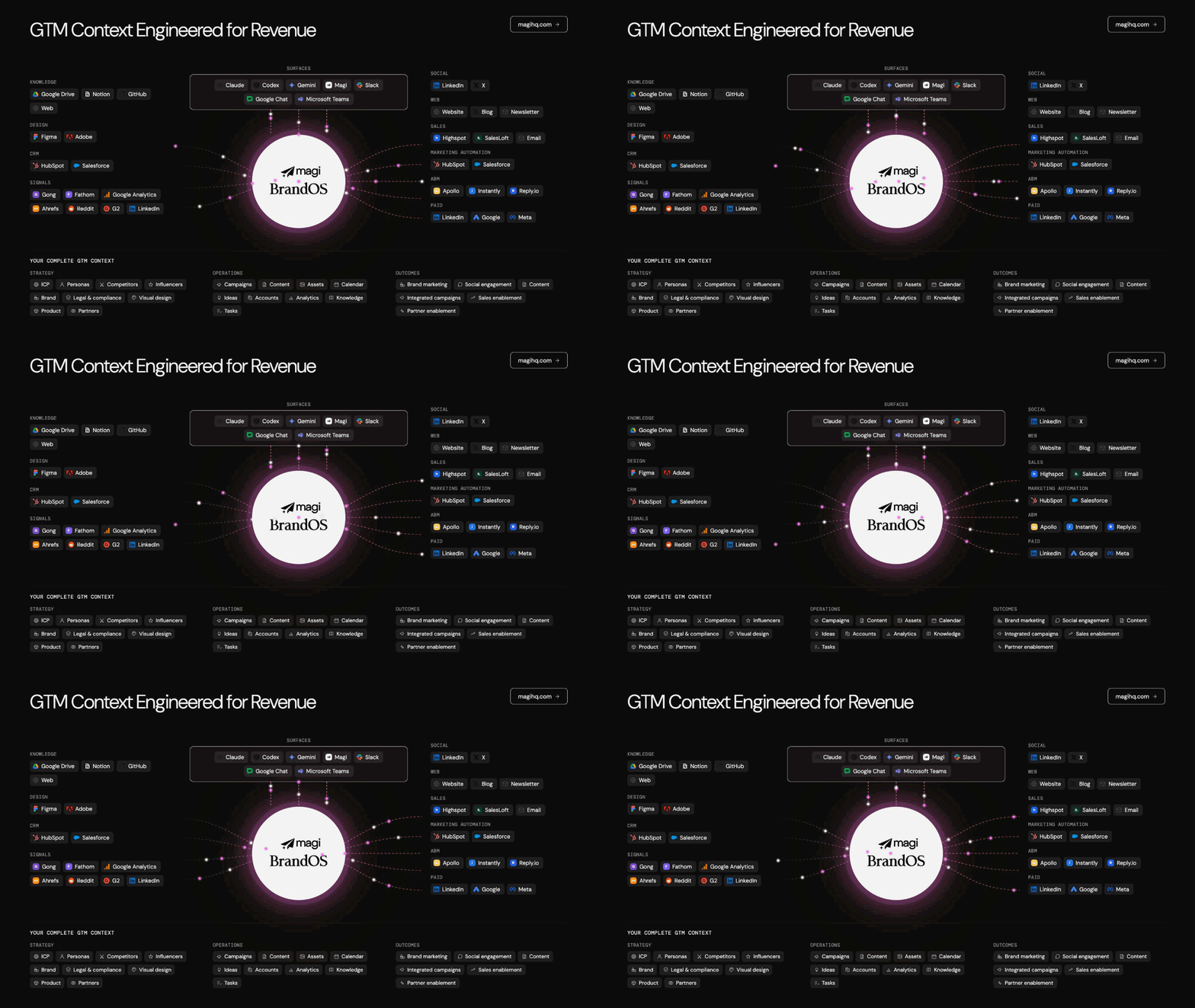
One identifies the moment; the other decides what to say in it. Neither is enough alone. You need both to run a GTM ecosystem that drives results.
HubSpot's own keynote showed the seam. The good sales email in their demo worked because it knew the product the buyer had trialed, how it compared to a competitor, the Gartner rating behind that comparison, the rep's usual follow-up style, and the right tone. The trial and the contact are customer record. The comparison, the positioning, and the voice are marketing context feeding a sales moment. That's what Magi is built to hold.
Today, Magi Creates and HubSpot Activates
Today, the Magi + HubSpot workflow moves finished marketing work into the activation system teams already use:
A marketer develops the brief and draft in Magi using the company's BrandOS and connected knowledge.
Magi checks the work against brand standards and designs the finished asset.
Newsletters and campaign emails move into HubSpot Marketing Email, including the header image.
Landing pages publish into HubSpot CMS.
HubSpot handles sending or publishing through the customer's existing system.
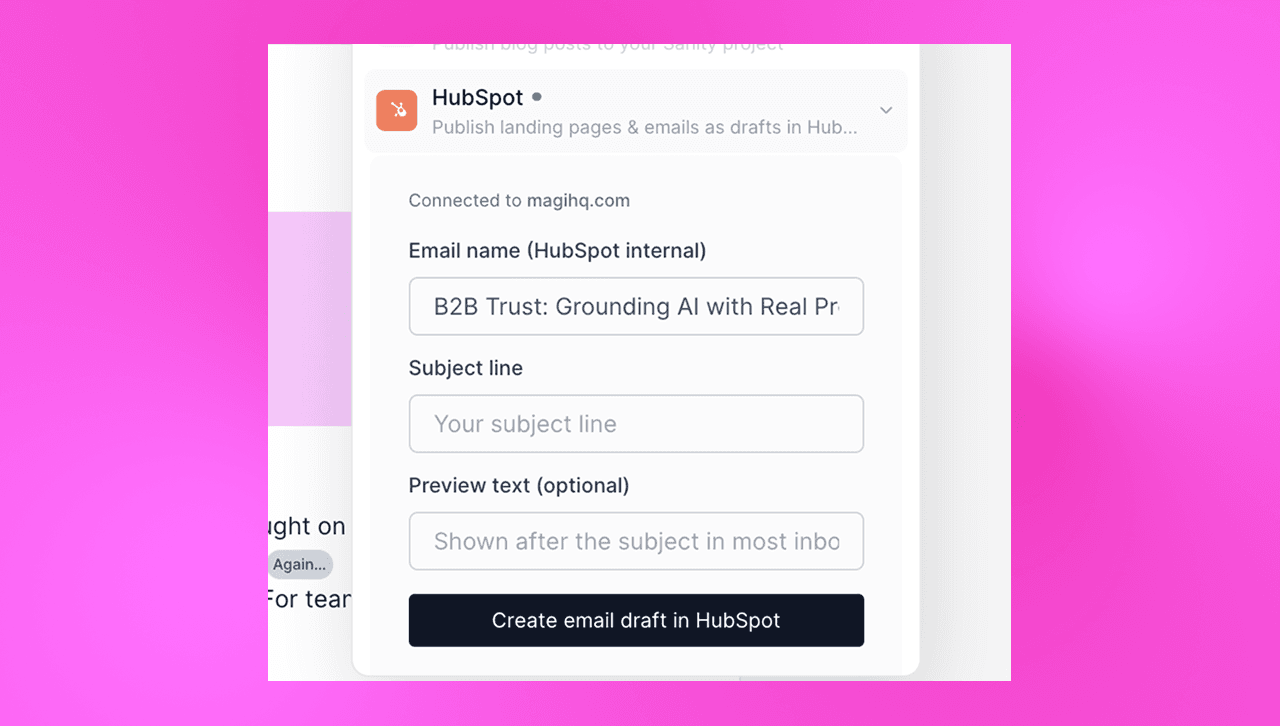
HubSpot is live today as a Magi publishing destination. Most integrations, including HubSpot, connect through one OAuth login, after which destinations appear in Magi's publishing flow. Magi handles context-grounded creation, brand checks, and design. HubSpot remains the activation layer.
Future Vision: Close the Outcome Loop
Today, Magi publishes into HubSpot. Next, HubSpot data would flow back into Magi, so the two sides finally connect:
Add won revenue and open pipeline by stage to Magi analytics.
Let campaigns target accounts using their HubSpot deal stage.
Identify contacts engaging with marketing activities so sales can prospect.
These connections would help marketing relate content engagement to pipeline and revenue, then give sales a more useful follow-up signal. Ecosystem value grows when information moves from customer systems into marketing decisions, then returns as measurable execution.
* This part of the flow is directional future vision, not yet generally available
Connect the Systems That Already Hold the Context
The context you need already exists. It's just split across systems. HubSpot holds the customer and revenue side; Magi BrandOS holds the marketing side and the governance that keeps work on brand. Connect them, and a team can go from a business signal to a finished, on-brand campaign. As Rangan said at Unbound, transformational companies are "not chasing, they're choosing." Connecting the systems you already run is how you choose.
Give your AI the context layer it's missing.
Already on HubSpot? See what Magi adds.
Frequently Asked Questions
What is a context layer?
What is a marketing ecosystem?
Does Magi integrate with HubSpot?